|
CAMN MONTHLY NEWSLETTER
August, 2026 | | | | PRESIDENT'S MESSAGE
Hello. Things slow down a bit in August. It’s a good time to head to the lake or the river with a wide brimmed hat, ample sunblock and a cool beverage. But not everyone is as lazy as me. The Curriculum Committee is roaring along with three Saturdays of NiT training in August. The topics focused on mammals, amphibians and endemic species. Also, Michelle Stoll and Willow Austin will have a presentation on carbon sequestration at the CAMN Monthly Meeting.
| | | I also want to thank Carole Yeung and Diane Skinner. They spent many hours digitizing CAMN’s historical record. Below you will find some of the interesting things that they uncovered.
The report on the first year of operation mentions that the first class of 31 Master Naturalists represented 12 counties. Members of the class came from Fayetteville, Pine Bluff, Hot Springs Village, and Batesville. Such was the beginning of a chapter that would lead to the current network of chapters throughout the state.
In reviewing Bert Turner’s files I came across his video of two rat snakes mating……what a lovely dance that was.
Finally, I took photos of the awards received by CAMN. One of the more unusual is attached.
Along with the mundane there were MANY photos and an amazing amount of documentation on the development of special projects. When Carole and I were finished what came to my mind was the breadth and depth of contributions of CAMN members to the community and the state. Some contributed hundreds/thousands of hours and others perhaps under forty…..BUT together they improved the environment of central Arkansas and cared for our resources. What an impressive group!
Dr. Paige Ford at the Plum Bayou Research Center (the old Toltec Mounds) is looking for a couple of volunteers to help with a garden there. I drove out recently to look at the garden. It is not large and appears to mostly need some regular TLC. The plants grown in the garden include food bearing plants and also plants used by indigenous people for fiber to make nets, shoes, clothing and basketry. So, it will be a little different from our usual native plant routine. Anyone interested please let Kerry Evans, our Project Coordinator, know and you can contact Dr. Ford at paigef@uark.edu. | 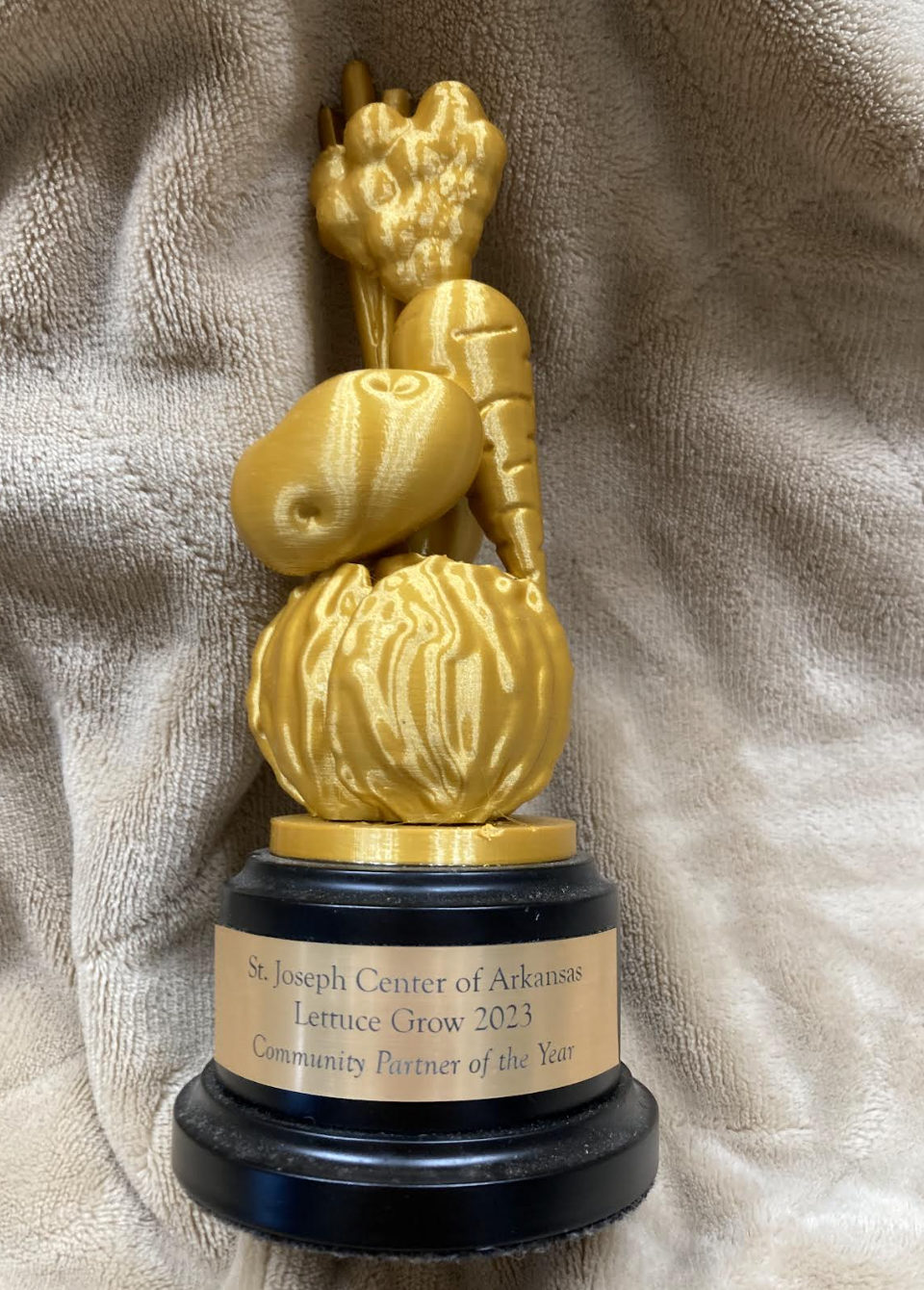 | CAMN General Meeting
Thursday, August 20th, 2026
Willow Austin and Michelle Stoll discuss carbon sequestration
Location: Witt Stephens Jr. Central Arkansas Nature Center
602 President Clinton Ave.
Little Rock, AR 72201
Time: 6:00 PM until 8:00 PM
Pizza at 6:00. $1.00/slice
Program 6:30--7:30. Counts as 2 hrs CE in person. Zoom available 1 hr CE. | Mark Your Calendars for Graduation
Our 2026 NiT class is an engaged, eager, and dedicated group. From foraging to tree ID, bats to botany, this group has worked hard and asked insightful questions! So mark your calendars to celebrate our new Master Naturalists at this year's graduation.The cookout-style event will be a great time to introduce folks who might be interested in CAMN. We will have project leaders on hand to talk about volunteer opportunities, so invite those potential future Master Naturalists!
When: October 10, 9 am -- Noon
Where: Big Maumelle Pavilion at Pinnacle Mountain State Park
Bring a dish to share if you're able and be sure to register on the CAMN website if you plan to attend. | Native Bell Class Change of Location!
The September 12 Native Bees and Hike NiT class will now be held at the Audubon Center instead of Camp Robinson SUA Building. So if you were thinking of attending this engaging class led by biologist Coleman Little but didn't want to make the drive to Conway, you are in luck! Don't forget to register.
| 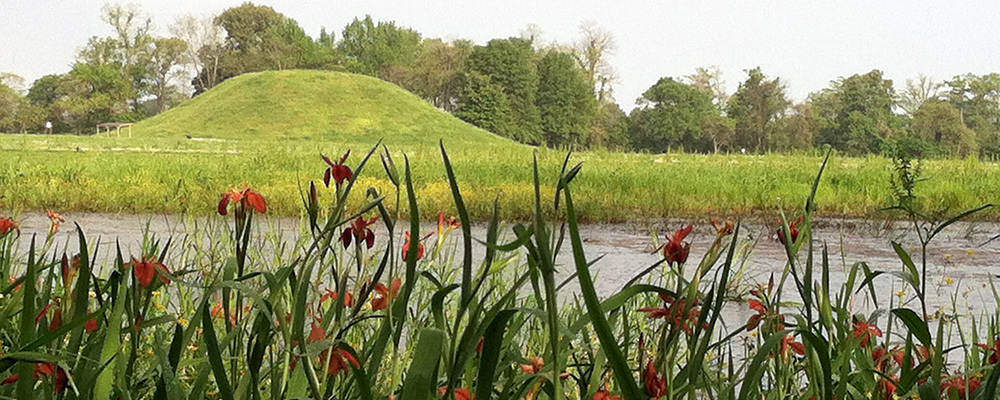 |
Volunteers Needed at Plum Bayou Research Station for Native Garden
Dr. Paige Ford, archaeologist at Plum Bayou (formerly Toltec Mounds) is looking for help with a native garden at the Plum Bayou Research Station. In addition to pollinator plants they are planting native crops. She said that she’d like to have help twice a week, but will take once a month is that is what we can muster.
If you are interested in being involved in a project like this, please respond to Kerry Evans klevans.301@gmail.com. CAMN needs someone to be the project lead on this (basically keep up with the volunteers who sign up here and make sure everyone is apprised of workdays.) Kerry will keep a list of all interested persons while we gather more information about scheduling from Dr. Ford.
Below is Dr. Ford’s contact info.
Paige Ford, PhD
Arkansas Archeological Survey Station Archeologist
Plum Bayou Research Station
490 Toltec Mounds Road
Scott, AR 72142
(501)961-2420
|  | | Arkansas Wild Spaces Website
Visit the Arkansas Wild Spaces website! Take a look, bookmark the page, and share with friends.
| 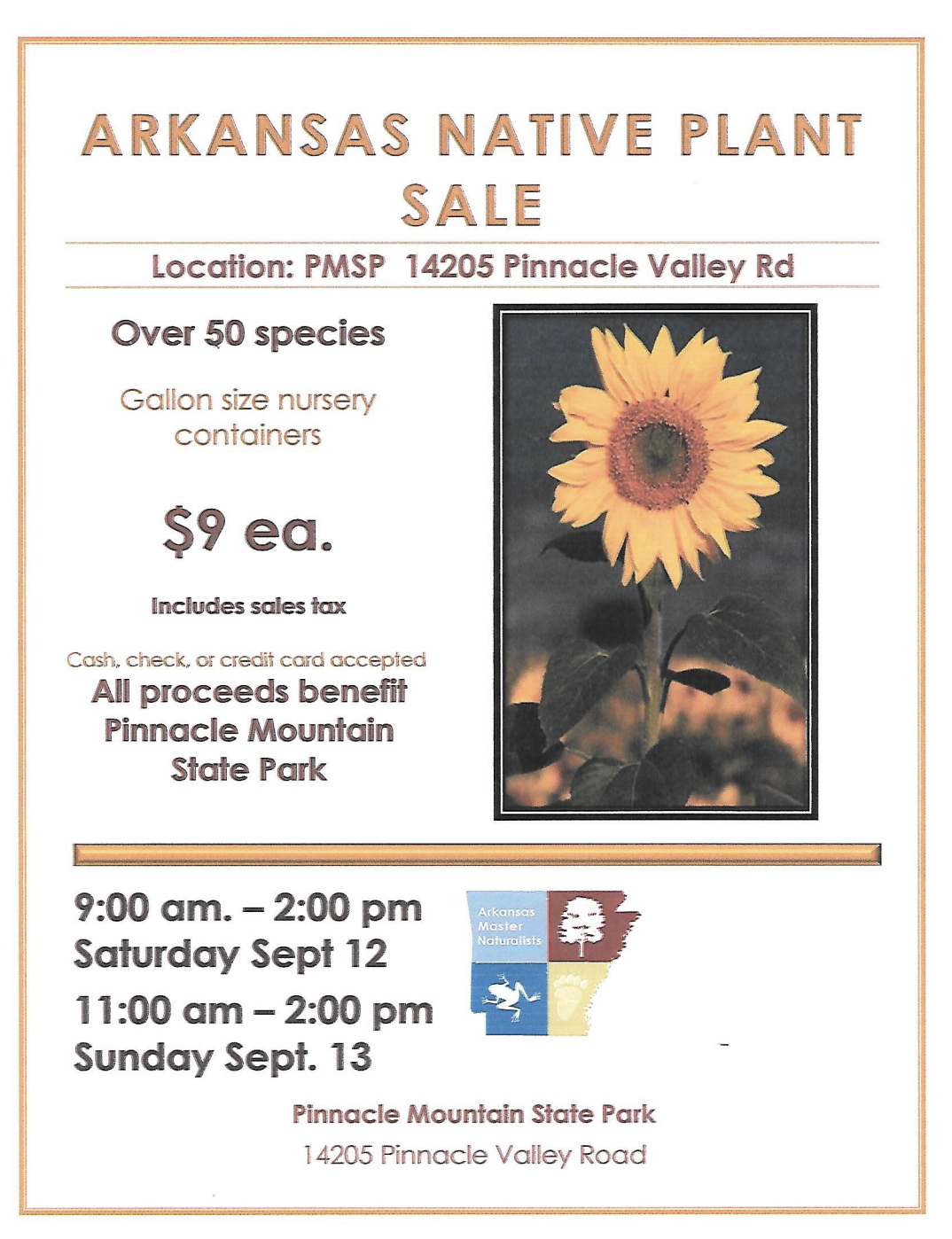 |
Our annual Pinnacle Mountain State Park fall native plant sale is scheduled on Saturday Sept 12 and Sunday Sept 13 at the times posted on flyer.
We will have provide CAMN members a presale opportunity to purchase plants at an earlier date to be determined.
We need your help in getting the word out. Post the flyer on your social media, place in shop windows, church bulletin boards, or wherever it can have some public exposure. I can send you a PDF file of the flyer if you need it. The park will post on their bulletin boards.
We have over 1100 pots (over 50 species available).
If you know of an organization that is planning a native plant pollinator garden, we will stage an area for plants to collected if people want to donate plants to that group. We will deliver those plants after the sale (Pulaski County) to a designated location the organization selects. We will need an organization name and contact with cell number and address. The organization will need to get the word out to their members. The price for a robust gallon size plant is hard to beat!
Note. Arkansas Wild Spaces (https:arkansaswildspaces.org/.) will provide printed materials about the importance of native plants, ways to make a yard more wildlife friendly, and DIY instructions for making a "Bucket of DOOM". They will also offer for sale a limited number of pre-made buckets.
|  |
CAMN Tree Planting
By Laura Smith-Olinde
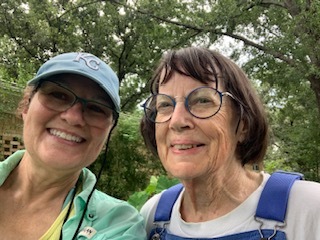
Kate and I worked this past Wednesday morning repotting 18 trees altogether, 12 seedlings in 1 gallon pots, 1 in a cup, 3 saplings in bags, 2 in larger pots. Of course we look fabulous but dang were we  . But we got a lot done. . But we got a lot done.
| Tree Replacement Project Update
By Kate Spontak
The Tree Replacement Project has been steadily adding to our stock of seedlings to give away this Fall. Thanks to Laura Smith-Olinde and Carol Trana we have been averaging 25 or so new trees in pots per week, as well as moving some to larger pots and bags. Thanks to Kate's shady yard and sprinkler system most are surviving the heat.
Oaktober is again in the works, led by Rachel Tanner, Master Naturalist and librarian at Dee Brown Library, building on the work of Audrey Cobb over the last two years.
Put the Oaktober kickoff date on your calendar - Sunday, October 4, 1 pm.
Working with John Pennington, he suggested a new opportunity -- offering new trees as a bounty for removing invasive trees and shrubs. Based on the program in Fayetteville, here is an outline of what that might look like. It needs a leader.
2026 Invasive Plant Bounty
Target species:
-
Bradford pear trees (Pyrus calleryana)
-
Chinese privet (Ligustrum sinense)
-
Mimosa or silk tree (Albizia julibrissin)
-
Golden bamboo (Pyllostachys aurea)
-
Nandina (Nandina domestica) aka heavenly bamboo
How it Works
All participants need to do is take a picture of their cut-down invasive tree or shrubs and email a photo of the removed plant to ________________, along with your name, email and phone number. A list of available native trees and shrubs will be released closer to the pickup period. There is a limit of two native species pickups per household, while supplies last.
"Best Before & After" Photo Contest
The photo submission deadline is March 20. Participants must show their progress with a "before" picture(s) of invasive plants or debris piles and an "after" picture(s) of cleared space or new plantings of non-invasive species. Creativity and humor are encouraged in photo submissions, whether that involve family, pets, captions or creative setups!
The ________________ will select the winning entries. Awards for best photo will be presented during Earth Week in late April.
-
Grand prize: a bird feeder with a camera, 2 “tree diaper” water bags, and an extra tree or shrub.
-
Four runner up prizes; one of either
-
The book "Trees, Shrubs, and Woody Vines of Arkansas" by local authors Jennifer Ogle, Theo Witsell and Johnnie Gentry, 2 “tree diaper” water bags, plus an extra tree or shrub
About the Program
Invasive species threaten habitat and native species by outcompeting native plants for critical resources. They spread quickly and choke out native trees, shrubs and flowers. Invasive plants usually have vigorous growth, reseed prolifically, displace natives, negatively alter forest environments and prevent natural habitat regeneration.
Please note that the City is unable to cut down your tree or shrubs; property owners should cut their tree or shrub or hire a company. The city along with volunteers will do removals in parks.
Right Tree, Right Place
Urban Foresters stress “Right Tree, Right Place.” Trees can take many years to reach their mature height and spread. Allow enough space between tree sites and buildings, driveways, and utilities. Residents should always contact Arkansas One Call at 811 or 800-482-8998 before digging.
Suggested project at 8/10/2026. Looking for Partners, Organizers, Communicators, Tech experts.
Would someone take on being the organizer?
We can provide the trees and the prizes, and lots of contacts.
| Updates from the Trail Team Workshop on July 18th
By Paul Gosnell
About 14 of us gathered at the Thompson Library, Saturday morning to conduct a Trail Team Workshop. The purpose of the workshop was to see what we are doing well, what we need to improve and identify actions and owners to close these gaps.
Things we do well:
- Good support from sponsors (NLR Parks, CAW, Ferncliff)
- Active involvement from Trail Coordinators and Trail Stewards
- Good communication within the Coordinators and Stewards teams.
- Outreach and partnership with groups like Scouts.
- The new structure isn't significantly different from our past way of working, but adds structure
Things we need to improve:
- Communication across the entire trail team
- The entire team doesn't see what other teams are doing and if you aren't a coordinator or steward you might not see volunteer opportunities.
- We need more structure and consistency, a schedule of activity, assignments and events getting posted to the calendar.
- We need more opportunities for NiTs, build a bridge between the trail team and the NiTs.
The same is true for Naturalists, not just the NiTs.
- Succession planning, we need one and it needs to be shared, we are at risk of losing Coordinators and Stewards as each year goes by.
Summary and Actions:
- Communication, that includes email, calendars, documents, hits all across our findings. It's not just having a tool, it's about having the discipline to use it. Google Workspace for CAMN is being rolled out. We need to use these tools. Email is available now (trails@camn.email).
| | Nature Ramblings: Unbidden Volunteers
By Lynn Foster
Part of the fun in establishing a pollinator garden is seeing what Nature brings to the table. We gardeners spend hours planning what plants to add and where to place them. Fellow CAMN member and friend Kate Lincourt says we offer up our selections to Nature and she chooses whether to accept them or not. This is so true! But Nature also plans secretively, and we only see her choices revealed over time. In this column I’m going to talk about just one such “unbidden volunteer” plant that has turned up in the Bowen pollinator garden at the UA Little Rock School of Law. By the way, if you want to see the garden, parking is free. It’s at 1201 McMath Avenue on the east side of the building (the back), where it gets full sun. It’s pretty raggedy right now, but we’ll be doing some serious maintenance this fall.
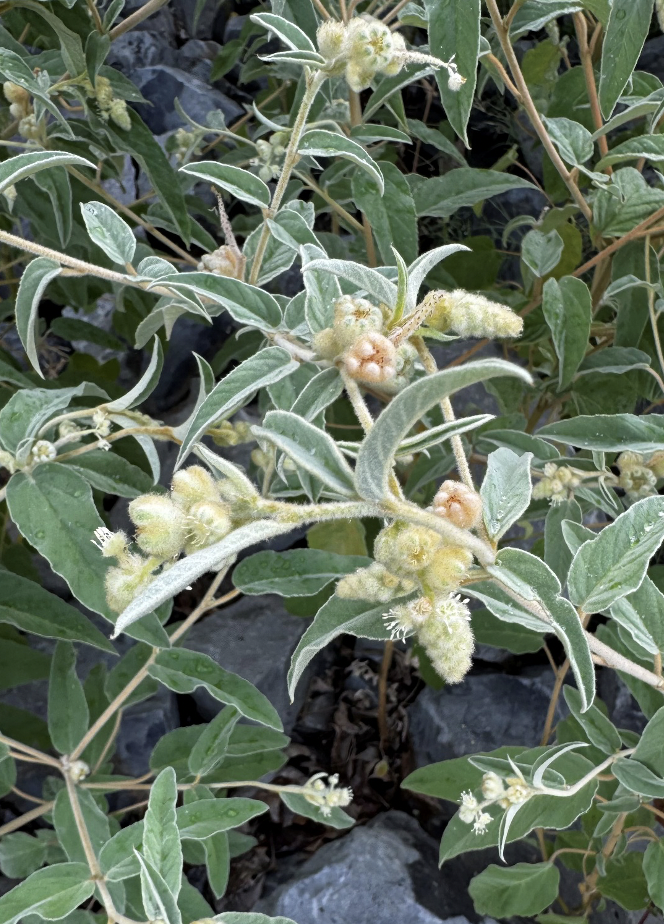
Pictured: Bed of Woolly Croton | | | Woolly Croton, or Hogwort, or Goatweed (Croton capitatus). During the summer of 2025 we had several seedlings. We let one grow, and it was monstrous, with a stem almost 2 inches in diameter. One plant makes a striking specimen plant if not crowded. It is an annual species, but it reseeded so successfully that despite our pulling numerous seedlings out of the garden bed, this year a colony grew up in the center of the garden, in a bard bed of large rocks fronting large water pipes that are flushed once a year.
Its silvery leaves and white flowers are unusual and striking. It grows to about 3 feet tall. Researching it, I learned that birds such as bobwhites, mourning doves, and wild turkeys eat its tiny seeds, although its leaves are toxic to livestock. It’s a host plant for gray hairstreak and goatweed leafwing butterflies. In fact, after a garden maintenance session, having taken bags of plant waste home to dump in my yard, two full days later I discovered a goatweed leafwing caterpillar in my car. I was able to drop him back off on a croton leaf at the law school.
|  | | Woolly Croton Flowers | 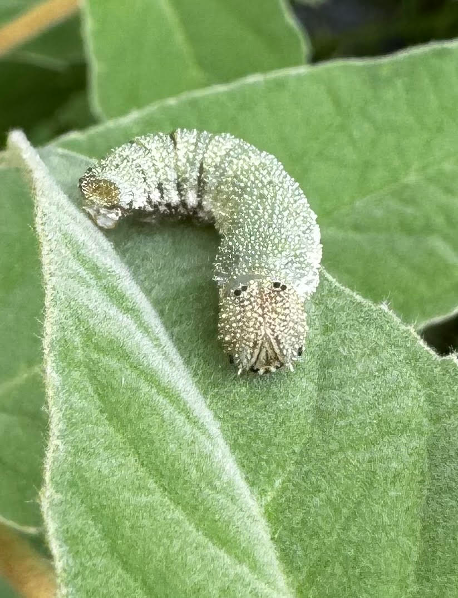 | Runaway Goatweed Leafwing Caterpillar, returned home | | |
Farmers understandably aren’t fans of woolly croton. I found one post on the Ask Extension website from a pasture owner in Texas wondering if anyone knew the longevity of its seeds (the answer: no). But one of its fans posted on In Defense of Plants (a great Facebook page you should check out, if you’re not familiar with it) that it’s a “fun, drought-hardy” plant. Which is exactly the way I think about it.
Are you interested in getting to know native plants up close? The Three Garden Gardeners maintain three pollinator gardens in public spaces, at the Law School downtown, UA Little Rock main campus, and Lavergne Circle. We have a few openings for folks who are interested. Contact me at lfoster5211@gmail.com. | |